
Fall Back Gently: A Flow-to-Nidra Ritual for the Time Change
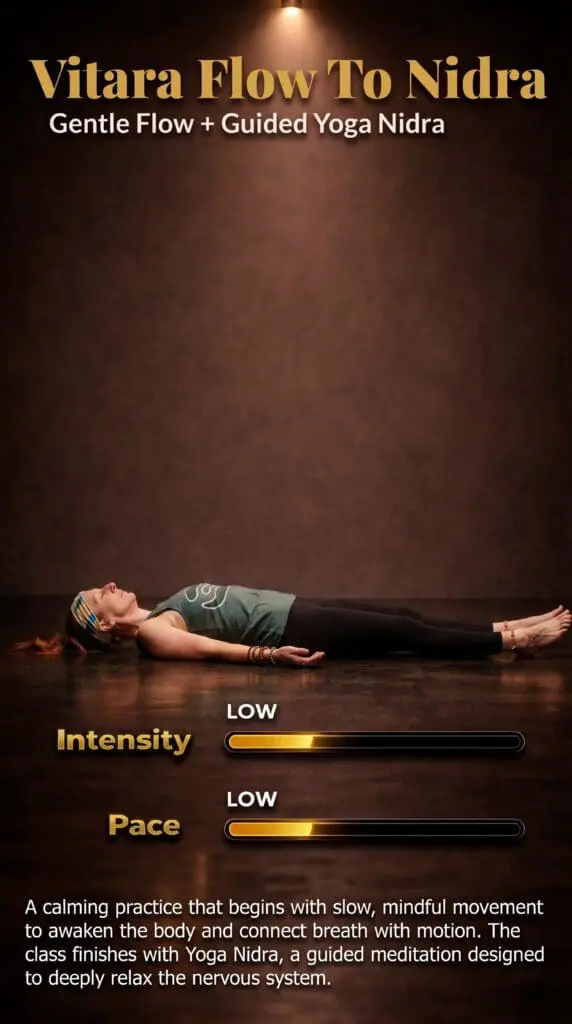
When the clocks fall back, use the change as a cue to make your evening simpler rather than trying to optimize your body overnight. A Flow-to-Nidra ritual can pair gentle movement with a deliberate transition into stillness. At Vitara, Flow to Nidra is a slow, meditative class that moves from accessible movement and breath awareness toward guided deep rest. It does not guarantee sleep or erase seasonal fatigue; it gives you a structured way to do less with attention.
Why a transition ritual can help
A clock change can make an ordinary routine feel slightly out of sequence. Darkness arrives at a different point in the day, familiar cues move, and your calendar still expects the same output. You do not need to label every response or force yourself to feel a certain way.
A ritual creates a clear edge between one part of the day and the next. Its value comes from repetition: the same lamp turned low, the same comfortable space, the same short set of movements, and a defined stopping point. The ritual is not a medical treatment. It is a practical way to reduce decisions when the evening feels unsettled.
Know what Flow to Nidra is at Vitara
Vitara describes Flow to Nidra as a low-intensity class with gentle movement, accessible transitions, breath awareness, slower pacing, guided deep rest, and longer stillness. The experience moves from soft activity toward a restorative finish.
The exact sequence and guidance can vary by teacher. This article does not promise a pose list, room procedure, or outcome. Review the current class description and arrive willing to follow the teacher rather than rehearsing an imagined class.
Flow to Nidra may fit when you want guidance and a slow arc into stillness. If you want only longer held floor postures, Yin has a different intention. If you want a more active beginning, Power to Yin may be another option.
Try a twelve-minute home transition
This short ritual borrows the idea of moving toward stillness. It is not yoga nidra instruction and does not replace a teacher-led class.
- Two minutes—arrive: Put the phone out of reach, sit or lie in a comfortable position, and notice the room without changing anything yet.
- Three minutes—move gently: Circle the shoulders, make a small seated or standing side bend, and use a comfortable cat-cow at a wall or on hands and knees.
- Two minutes—reduce effort: Rest forearms on a chair or counter and step back into a supported fold, then slowly return upright.
- Three minutes—be supported: Lie down with lower legs on a chair or sit with your back supported. Let the hands rest and allow the breath to find its own pace.
- Two minutes—close: Name the next necessary action, such as changing clothes or preparing for bed. Skip the unnecessary ones.
Stop earlier if that is enough. The purpose is a clear descent in effort, not completing twelve perfect minutes.
Build the room around fewer decisions
Before the ritual or class, choose what can be decided once:
- Set out comfortable clothing.
- Use one low, steady light instead of moving between bright tasks.
- Choose a place where you can be supported without needing special equipment.
- Tell household members when you will be unavailable, if appropriate.
- Decide what “finished” means so the ritual does not expand into another project.
If quiet is not available, the practice can still work. Use a familiar sound level and focus on the boundary you can create rather than waiting for ideal conditions.
Choose the class, then protect the margin
If you attend Flow to Nidra, check the live schedule and reserve the actual class time. Leave enough margin before class to arrive without rushing and after class to avoid immediately stacking another demanding task.
That margin may be fifteen quiet minutes in the car, a simple meal already planned, or permission not to answer messages immediately. It does not need to become a full wellness routine. One protected transition can be enough.
New to Vitara? Review the first-visit guide so check-in details are familiar before you enter a slower class.
Let the ritual be seasonal and flexible
Repeat the home ritual for three evenings or choose one Flow-to-Nidra class near the time change. Then ask what was useful: the movement, the lower stimulation, the support, the guided structure, or simply the decision to stop.
Keep that part. Remove anything that felt ceremonial without being helpful. A seasonal ritual should fit your real evening, including work, family, pets, noise, and limited space.
If the clock change passes and the ritual no longer appeals, release it. Consistency does not require keeping every practice forever.
Frequently asked questions
Is Flow to Nidra the same as a sleep class?
No. Vitara describes it as gentle movement leading into guided deep rest and stillness. Some students may feel settled afterward, but the class does not guarantee sleep.
Do I need yoga nidra experience?
No prior experience is required to listen to teacher guidance. Arrive early, ask questions, and choose a comfortable supported position.
What if I become restless during stillness?
Restlessness does not mean you are doing it wrong. Adjust your position, keep eyes open if preferred, or quietly return attention to a simple sensation such as contact with the floor.