
Why Music Can Change the Feel of a Yoga Class
Music can change how a yoga class feels without changing the poses. Tempo may make transitions feel more energized or more spacious. Familiar songs can create warmth, while unfamiliar music may help you listen differently. Lyrics can motivate one student and distract another. None of these responses is the correct one. A playlist is part of the room’s atmosphere, and your experience of it will remain personal.
Tempo offers a suggestion, not a command
A strong beat can make repeated movement feel cohesive. A softer or slower track can create more space around transitions. The risk is treating tempo as an instruction you must obey. Your movement still belongs to your breathing, understanding, and current capacity.
If a song accelerates and you notice yourself rushing, shorten the movement or pause for a cycle. If a slow song makes you hold longer than is useful, come out. The playlist can support a class arc without becoming the authority on your body.
Familiarity changes attention
A song you know may create immediate recognition. You might feel energized, remember another time, anticipate the next phrase, or start mentally following the lyrics. That can make a difficult sequence feel more approachable—or pull attention away from a cue.
Unfamiliar music has its own possibilities. Without a personal story attached, you may notice rhythm, texture, or the room more clearly. You may also dislike it. Yoga does not require a particular musical taste, and one playlist does not define whether you practiced well.
Volume and lyrics affect access
Students need to hear safety-relevant directions and understand setup. Music that feels immersive should still leave room for teacher cues. Individual hearing, sensory sensitivity, fatigue, and position in the room can change what “comfortable volume” means.
If you cannot hear, ask the teacher where you might set up more effectively or let them know after class. If lyrics feel distracting, use a concrete anchor such as the teacher’s next action cue or the pressure of your feet. If the sound is overwhelming or causes distress, leaving the room is allowed.
Different teachers bring different voices and class energy. Learning what kind of guidance helps you can be as useful as learning which playlist style you prefer. Compare class formats through Vitara’s class descriptions.
Use a four-part listening check
Try this during one class without turning it into another task to perfect:
- Arrival: What do you notice first—beat, volume, lyrics, silence, or your reaction to the song?
- Movement: Does the music make you rush, hold back, or find a steady rhythm? Adjust your pace if needed.
- Stillness: When movement slows, does the sound help you settle or keep your attention busy? Neither answer is a failure.
- Afterward: Which part of the soundscape supported you, and what made practice harder?
This check can help you choose classes more thoughtfully. It can also help you give useful feedback: “I had trouble hearing cues from where I was,” is more actionable than deciding you are simply bad at focusing.
Music can support a shared room without making everyone the same
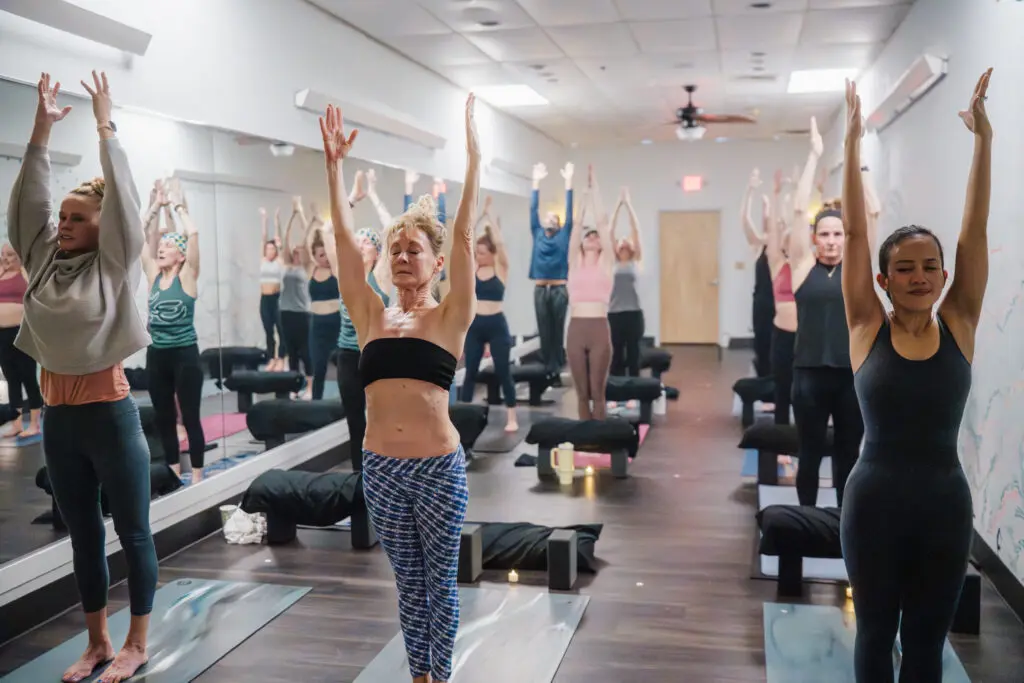
When a group moves within the same soundscape, the room may feel connected. That connection does not require identical timing or emotion. One student may be energized by a chorus while another quietly takes child’s pose. Someone else may barely notice the song because they are concentrating on balance.
Vitara describes its studio around movement, music, and meaning, but meaning is not manufactured by a playlist. It emerges through the teacher’s guidance, your choices, the people practicing beside you, and the care given to the room. See more of that setting on the Our Studio page.
Frequently asked questions
Is music traditional in every kind of yoga?
No. Yoga is practiced in many lineages and settings, with chanting, instruments, contemporary playlists, ambient sound, or silence. A studio playlist is one modern class choice.
What if I dislike the playlist?
You can still have a useful practice. Notice whether the issue is preference, volume, lyrics, or hearing cues. If it consistently disrupts your experience, try another teacher or class style.
Should I move on the beat?
Only when that rhythm supports clear, comfortable movement. You can move more slowly, take an extra breath, or pause while the music continues.