
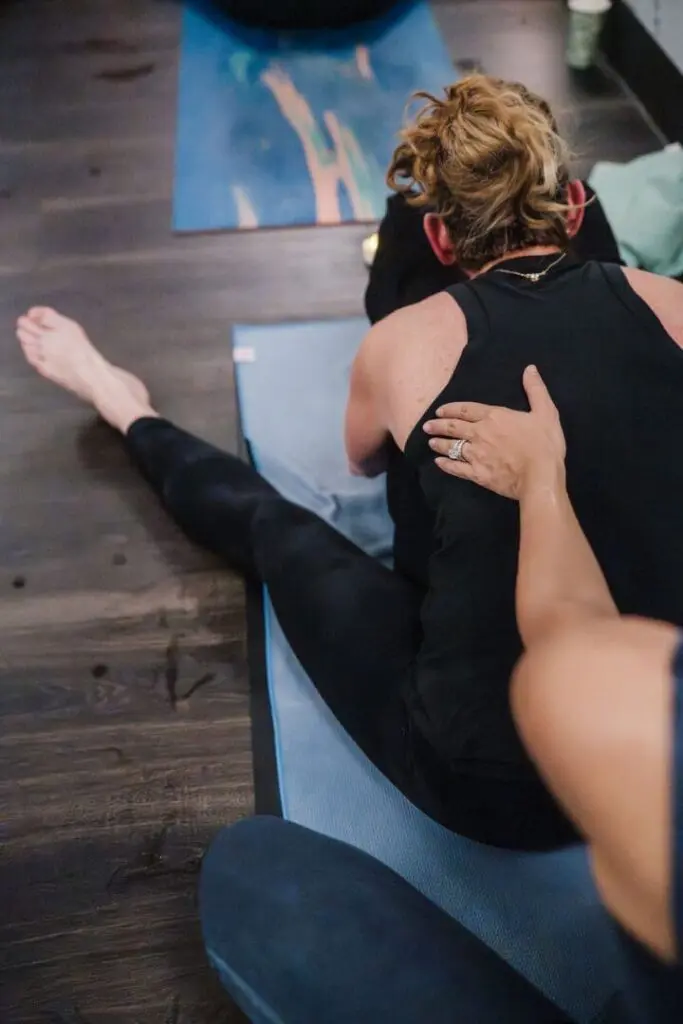
Screen-Day Shoulders: Five Gentle Movements Before You Unplug
After a screen-heavy day, give your shoulders five gentle movements rather than trying to force them “open.” The sequence below uses small circles, supported reach, rotation, and rest. It is designed as a transition out of work mode, not a treatment for pain or a correction for posture. Move within a comfortable range, keep your breath easy, and let the first repetition be smaller than you think you need. If a movement increases symptoms, skip it.
Do not turn posture into a verdict
Screen work can keep you in one position for a long time, but there is no single posture you must maintain all day. Bodies shift, lean, rest, and adapt. The goal of this reset is not to label your shoulders as rounded or wrong. It is to offer movement after stillness.
Notice the language you use. “My shoulders are ruined” creates urgency without information. “My right shoulder feels less willing to lift than my left” gives you something specific to respect. The reset may feel pleasant, neutral, or unnecessary. You do not have to manufacture a stretch sensation.
For a broader workday routine, the six-minute desk mobility reset adds hips, spine, and standing movement.
Begin with a thirty-second self-check
Sit or stand as you are. Without correcting anything, notice:
- Can you turn your head comfortably in both directions?
- Does one shoulder feel different from the other?
- Can you breathe without lifting or bracing the shoulders?
- Do you have pain, numbness, tingling, weakness, dizziness, or a recent injury?
- Would support or rest feel better than movement?
This is not a diagnostic exam. If you have new or concerning symptoms, use the information to stop and seek appropriate guidance.
Try the five-movement sequence
1. Small shoulder circles
Let arms hang. Move both shoulders gently forward, up, back, and down in a small circle three to five times. Reverse. Reduce the circle if you feel pinching.
2. Wall-supported reach
Place hands on a wall around chest height and step back until arms feel long. Soften the knees and send the hips slightly back. Keep the head between the arms or a little higher. Return before the stretch becomes intense.
3. Seated open-and-close
Sit with feet grounded. Reach arms forward as if holding a large ball and let the upper back widen. Then open the arms only as far as the front of the shoulders remains comfortable. Move slowly three times.
4. Supported rotation
Cross arms over the chest or rest hands on the ribs. Turn the torso a small distance to one side without pulling with the arms. Return through center and switch. Keep the pelvis facing forward if comfortable.
5. Forearms-down rest
Place forearms on a desk, counter, or chair. Step back slightly and let the head remain supported by your own neck or rest the forehead on stacked hands if that is comfortable. Stay for several easy breaths, then rise slowly.
Adjust the environment, not only your body
A useful reset may also point to a work setup issue. Try one change tomorrow: move frequently used items closer, raise reading material, vary sitting and standing if available, or schedule a brief movement cue between tasks.
Props can make movement more accessible. A wall, chair, or block changes the distance to support. The article Why Props Are Part of the Practice explains why support belongs inside yoga rather than being reserved for people who cannot do a pose.
Change one variable at a time. If you replace the chair, keyboard, routine, and exercise all at once, you will not know which adjustment helped or aggravated the day.
When to pause and get help
Stop if a movement causes sharp pain, symptoms that travel down an arm, new numbness or tingling, weakness, dizziness, loss of coordination, or sensations that worsen with repetition. Seek prompt medical care for chest pressure, trouble breathing, sudden severe pain, signs of stroke, a major injury, or another urgent concern.
The NCCIH notes that yoga injuries can occur and advises people with health conditions or prior injuries to discuss individual needs with a health care provider and qualified instructor. Do not use this sequence to postpone care or override clinician guidance.
Use the reset as a closing signal
After the fifth movement, put away one work item, lower the screen, and decide what comes next. The sequence works best as a boundary, not as five movements completed while continuing to read email.
If you want a longer teacher-led practice, compare Vitara’s class formats and use the live schedule. Choose based on your current energy and symptoms rather than assuming a stronger class will fix the day.
Frequently asked questions
Should I hold each shoulder stretch for a long time?
No. This sequence uses gentle movement and brief support. Longer holds are not required, and intensity is not the goal.
What if one side moves less?
Let the sides differ. Do not force the smaller side to match. If the difference is new, worsening, painful, or accompanied by weakness or numbness, seek appropriate evaluation.
Can I do this sequence at my desk?
Yes, if you have stable support and enough space. Move away from rolling chairs or obstacles and skip any movement that does not feel controlled.