

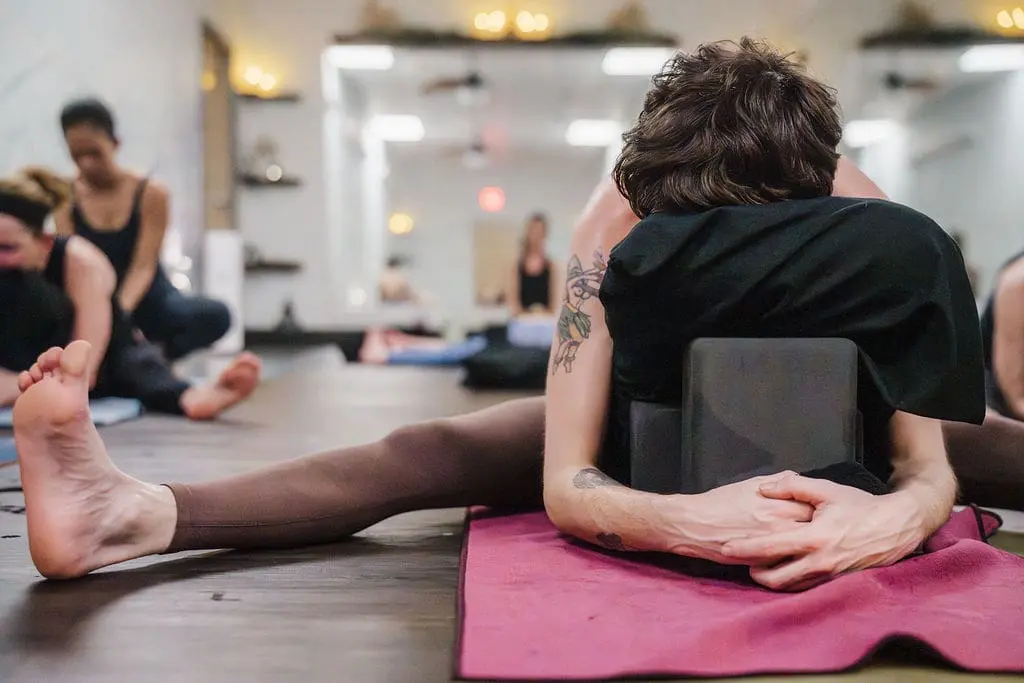
Is It Your Hips or Your Hamstrings? A Teacher-Led Exploration
If a forward fold feels limited, you cannot reliably conclude that your hamstrings—or your hips—are “the problem.” Your pelvis, hip joints, hamstrings, spine, knees, and nervous system all participate in the shape. The more useful question is: What changes when I alter one variable? A teacher-led exploration can help you compare sensations without turning a normal difference into a diagnosis or forcing a deeper stretch.
Why “tight” is not a precise answer
People use “tight” to describe many experiences: a broad pull, a hard stop, effort, unfamiliarity, compression, or simply less range than expected. Those sensations do not all mean the same thing. They also do not tell you that a muscle needs to be stretched more aggressively.
In a seated forward fold, for example, straight knees increase length through the back of the legs. The shape of your hip joints and the position of your pelvis influence how you tip forward. Your spine may round to create the appearance of more depth. If you only measure how close your hands come to your feet, you miss most of the conversation.
Try a three-part comparison
Move slowly and stay in a range where you can breathe normally. This sequence is an observation tool, not a test you pass.
- Supine leg comparison: Lie on your back with both knees bent and feet on the floor. Loop a strap around one foot and extend that leg upward only as far as comfortable. First keep the lifted knee generously bent. Then, without pulling harder, explore making the leg a little straighter. Notice where the sensation appears and whether your pelvis remains settled.
- Supported figure four: Keep one foot on the floor and cross the opposite ankle over the thigh, away from the knee. Stay there or draw the legs closer without lifting your head. Notice the outer-hip experience. Compare it with the back-of-leg sensation from the first shape.
- Half-kneeling front-of-hip check: Come to a padded half-kneeling position with support nearby. Keep the range small and gently shift your pelvis forward without arching dramatically. Notice whether sensation appears at the front of the kneeling-side hip. Return to neutral and repeat rather than holding deeply.
Pause between shapes. The goal is to distinguish experiences, not to decide that one body part is defective.
Change one variable in a forward fold
Now sit on a folded blanket or block with your legs comfortably forward. Try three versions for two or three breaths each:
- Bend both knees and rest your hands beside you.
- Keep the knees bent and tip forward from the pelvis only a small amount.
- Return upright, then straighten the legs somewhat without folding.
Ask what changed. If bending the knees makes it easier to tip the pelvis forward, reduced hamstring demand may be part of that difference. If sitting higher creates more room, the support changed your starting position. If the fold still feels blocked, the answer is not automatically “stretch harder.” Your individual structure and current state matter.
Props make these comparisons more accessible. The guide to using blocks, straps, and knees-down options explains why support belongs in the practice rather than outside it.
What a teacher can—and cannot—do
A teacher can help you change setup, reduce range, compare options, and notice whether you are holding your breath or bracing. A teacher can offer language that shifts the goal from “touch your toes” to “find a position you can explore.” A yoga teacher cannot diagnose an injury or determine a medical cause from watching one pose.
Choose a class pace that leaves room for those decisions by reviewing Vitara’s class descriptions. Tell the teacher about relevant limitations before class, while remembering that sharing information with a teacher is not a substitute for clinical care.
When to pause and get help
Stop the exploration for sharp or escalating pain, numbness, tingling, sudden weakness, loss of coordination, or symptoms connected to a recent injury. The NCCIH yoga safety guidance recommends not using yoga to postpone care for a medical problem and notes that existing injuries or health conditions may require modifications. Contact an appropriate licensed clinician for persistent, concerning, or unexplained symptoms.
Frequently asked questions
Should I stretch my hamstrings every day?
There is no universal schedule. More frequent stretching is not automatically better. Consider how you respond, what other activity you do, and whether the practice leaves you comfortable rather than irritated.
Does touching my toes mean my hips are mobile?
No. Toe-touch depth can come from several places, including spinal movement, knee position, limb proportions, and practice strategy. It is not a complete mobility score.
Why does one side feel different?
Side-to-side differences are common. Use comparable support and range, but do not force the less mobile-feeling side to match the other.