
Yin, Power to Yin, or Flow to Nidra: Which Way of Slowing Down Fits You?
Choose Vitara Yin when you want the most stillness, Power to Yin when you want to move before settling, and Flow to Nidra when you want gentle movement that transitions into guided deep rest. All three offer a slower direction, but they do not arrive there in the same way. The best choice depends less on which class is “most relaxing” and more on how much movement helps you become present today.
Choose Yin for the quietest physical pace
Vitara Yin is built around supported stillness and longer-held shapes, with much of the practice seated or reclined. It suits a day when you do not need much movement to arrive. The challenge is often less about speed or strength and more about staying present without forcing range.
Choose Yin if you want time to arrange props, notice the first layer of sensation, and make small adjustments. “Still” does not mean you must remain frozen. You can change support, reduce the shape, or come out before the teacher cues a transition. The useful quality is unhurried attention.
Choose Power to Yin when movement helps you settle
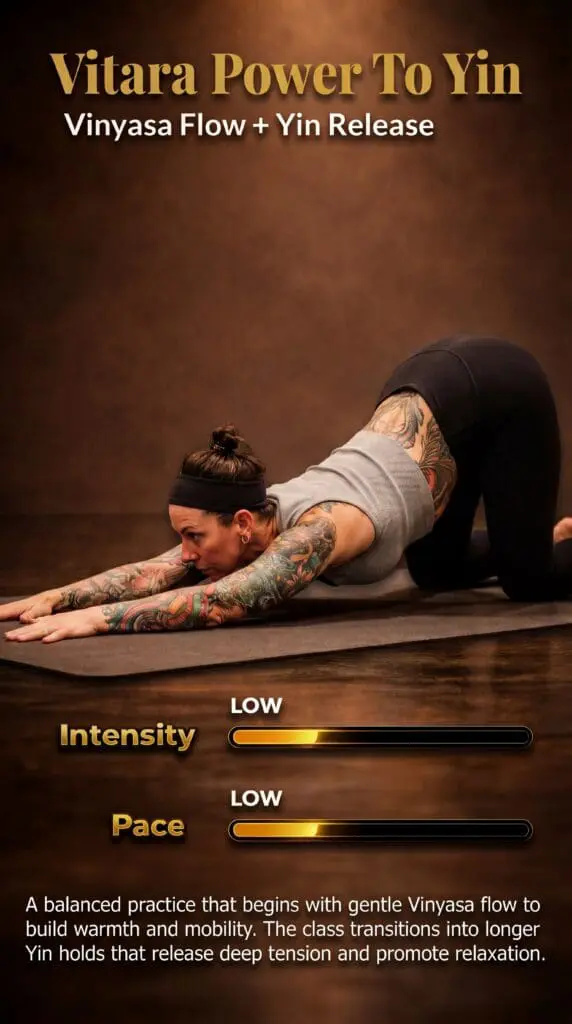
Power to Yin begins more actively. Breath-led movement warms the body and gives your attention a task before the class gradually shifts into slower, Yin-inspired stretches. It can be a good bridge when jumping directly from a busy day into long stillness feels abrupt.
The “power” in the name does not require you to maximize every movement. You can choose accessible ranges and then notice how the quieter second part feels after moving. If you like a class with a clear arc—effort first, release later—this format may feel intuitive.
Choose Flow to Nidra for movement into guided rest
Flow to Nidra uses gentle, mindful movement and slower transitions before moving into a guided Yoga Nidra portion with longer stillness. Compared with Yin, the destination is less about a series of longer stretch-based postures and more about the shift from soft movement into guided rest.
This may fit a day when you want some physical orientation without an athletic start. The earlier guide to what happens in Vitara Flow to Nidra offers more first-class context. No particular feeling is guaranteed; you may leave quiet, thoughtful, energized, emotional, or simply glad you paused.
Use this four-question decision tool
- How much movement do I want before stillness? Almost none points toward Yin; a meaningful active phase points toward Power to Yin; gentle movement points toward Flow to Nidra.
- What helps my attention arrive? If detailed physical setup helps, choose Yin. If a moving rhythm helps, consider Power to Yin. If listening to guided rest feels accessible, consider Flow to Nidra.
- What kind of ending do I want? Yin continues through slower postures, Power to Yin settles after an active arc, and Flow to Nidra culminates in guided stillness.
- What can I honestly participate in today? Choose based on current capacity, not what you think your week should contain.
If two answers point in different directions, either class can be useful. This is not a personality test; it is a practical way to reduce guessing.
Account for the heated room
Slower classes at Vitara still take place within a hot-yoga studio. A quiet pace can make the room feel different, but it does not make heat irrelevant. Arrive hydrated, tell the teacher you are new, and leave any shape or the room when you need to. If heat may be a concern because of pregnancy, symptoms, medication, or a health condition, discuss it with an appropriate clinician before attending.
Read the complete Vitara class descriptions before choosing. They provide the clearest current comparison of pace and format, while the live schedule shows what is actually available.
Frequently asked questions
Which class is best for a beginner?
All three can offer approachable elements, but the best first choice depends on whether stillness, an active-to-slow arc, or guided rest feels easiest to enter. Tell the teacher you are new.
Is Yin the same as restorative yoga?
No. Both may use support and slower pacing, but class intentions and pose choices can differ. Use Vitara’s current description rather than assuming the labels are interchangeable.
Do I need to be good at meditation for Flow to Nidra?
No. Listening, losing the thread, becoming distracted, and returning to the guidance can all be part of the experience. There is no required mental state.