

Yoga for Cyclists: A Post-Ride Mobility Practice
After a ride, yoga can be a gentle change of position—not a requirement to “undo” cycling or force your body back into balance. A useful post-ride mobility practice moves through ankles, hips, spine, and shoulders with support and an easy breath. Keep the range modest, especially after a long or hard effort. You are gathering sensation and restoring variety to your movement, not proving how flexible a cyclist should be.
Let effort come down first
Do not step off an intense ride and immediately pull into your deepest forward fold. Walk for a few minutes, let your breathing become conversational, and take care of ordinary needs such as fluids, food, and changing out of damp gear. The best range after a ride may be smaller than the range you find on a separate recovery day.
Notice whether you are using the mobility session to listen or to bargain with yourself: “If I stretch hard enough, the ride counts as balanced.” Your body does not need that transaction. Five to ten attentive minutes can be complete.
Try this eight-minute post-ride sequence
- Ankle circles, one minute: Sit or stand with support. Lift one heel lightly and trace slow circles through the ankle, then change direction and sides. Keep the movement smooth rather than large.
- Supported calf shift, one minute: Face a wall with both hands supported. Step one foot back and explore bending and straightening the back knee while the heel stays comfortable. Switch sides halfway through.
- Half-kneeling hip movement, two minutes: Pad the back knee and keep a chair or blocks nearby. From a short half-kneeling stance, gently shift forward and back. Avoid pushing the pelvis as far as possible. Change sides after several slow repetitions.
- Reclined figure four, two minutes: Lie down with knees bent. Cross one ankle over the opposite thigh, away from the knee. Stay or draw the legs closer. Keep your head down and use a strap if reaching creates strain. Switch sides.
- Reclined twist, one minute: Place both feet down, let the knees move a small distance side to side, and allow the shoulders to stay easy. This can be a moving exploration rather than a held end range.
- Supported chest opening, one minute: Sit or kneel comfortably. Interlace hands behind your head and widen the elbows only as far as your neck remains relaxed. Return elbows forward, then reopen several times.
The timing is a guide. Spend less time if fatigue makes your positions collapse, and stay longer only when the sensation remains calm and useful.
Choose support before depth
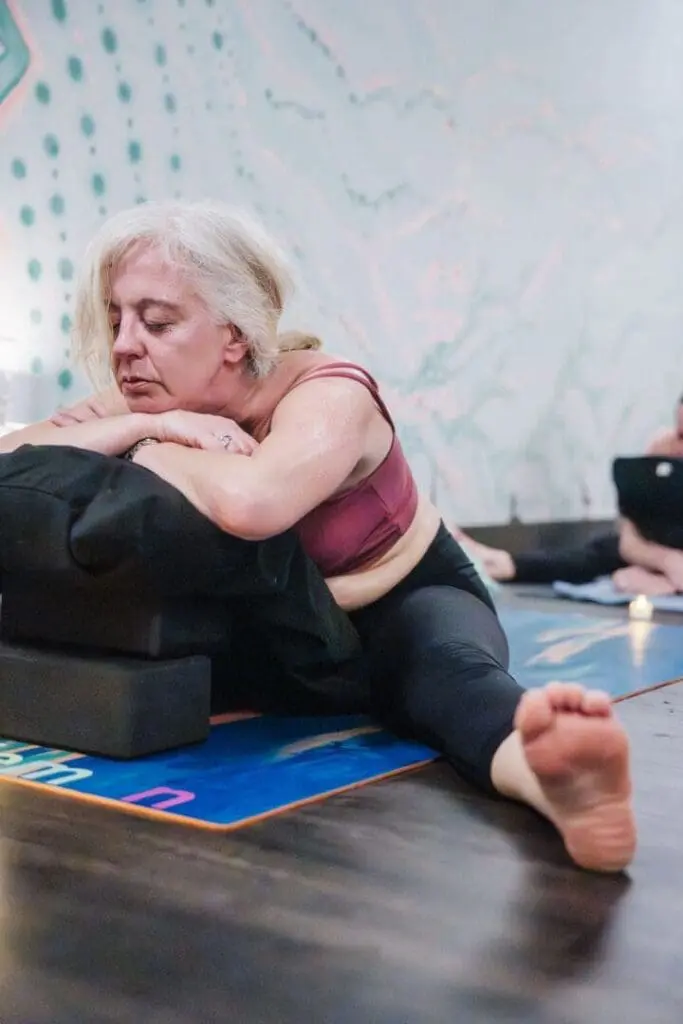
Cyclists often arrive with a strong idea that hamstrings and hip flexors must be stretched. Those areas may feel noticeable, but a deep sensation does not tell you what needs fixing. Raise the floor with blocks, bend your knees, and use a strap so your grip and back do not do extra work.
The article on why props are part of yoga practice offers more ways to make support intentional. In a post-ride context, support also helps separate mobility from another strength session.
Match the yoga class to the ride
A hard ride does not automatically require the slowest possible class, and an easy ride does not obligate you to take a powerful one. Consider total effort across the week. If your legs are heavily fatigued, a quieter class or an additional rest day may make more sense. If the ride was short and easy, you may enjoy more movement.
Compare pace and format on Vitara’s class descriptions page. Remember that Vitara is a hot yoga studio; heat adds another demand to consider after outdoor training, especially on warm days. Arrive recovered enough to make clear decisions rather than using the class to test your toughness.
When to pause and get help
Stop if you experience sharp or escalating pain, numbness, tingling, loss of coordination, faintness, chest pain, or unusual weakness. Do not stretch through a recent crash injury or use yoga to delay assessment of persistent symptoms. The NCCIH yoga safety guidance notes that injuries and health conditions can require modifications and recommends not postponing medical care for a problem.
If you feel faint or weak after exercising in heat, stop activity and move to a cool place, consistent with CDC heat guidance for athletes. Seek urgent care for severe or worsening symptoms.
Frequently asked questions
Should I do this sequence immediately after every ride?
No. Use it when a brief mobility change feels appropriate. After a demanding ride, food, fluids, cooling down, and rest may deserve priority.
Will yoga prevent cycling injuries?
No routine can guarantee injury prevention. Yoga can add movement variety and awareness, but training load, bike fit, recovery, health history, and many other factors also matter.
Can I take hot yoga after riding outdoors in summer?
Consider the combined heat and effort, not each activity in isolation. If you feel depleted, overheated, dizzy, or poorly recovered, skip the heated class and recover.